
Side Events
Side Events at GHS2026
Welcome to GHS2026 Side Events!
We are thrilled to announce that GHS2026 will see a variety of side events to complement the main conference.
These side events will provide delegates with additional opportunities for networking, learning, and engaging with global health experts.
Stay tuned for more details as we finalise the schedule and locations for these exciting side events. We are working hard to curate a diverse range of event activities, meetings, and workshops that cater to different interests and professional backgrounds in the field of global health.
Whether you are looking to attend workshops on healthcare innovations, panel discussions on global health challenges, or networking sessions with leading experts, our side events will offer something for everyone. They are designed to enhance your overall conference experience and provide valuable insights and connections in the field of global health.
Make sure to bookmark this page and check back frequently for updates. We will be sharing more information about the side events, including how you can register and get involved in shaping the future of global health.
Thank you for your enthusiasm and support as we prepare for GHS2026. We can’t wait to welcome you to these exciting side events that will add even more value to your conference experience in the dynamic field of global health.
See you at GHS2026!
Global Health Security and Pandemic Preparedness: Overcoming Challenges through Collaboration
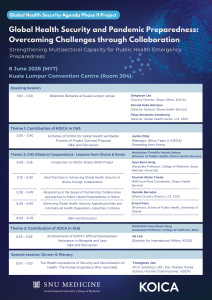
The COVID-19 pandemic and Mpox outbreaks exposed critical gaps in global health infrastructure. Bridging these gaps require more than just local action; it demands multisectoral synergy and international partnerships. This side event, organized by Seoul National University (SNU) in collaboration with Korea International Cooperation Agency (KOICA) and Korea Disease Control and Prevention Agency (KDCA), offers a deep dive into practical, real-world strategies for building resilient health systems.
A centerpiece is the “GHSA Phase II Project” in Ghana. This session will showcase how bilateral cooperation—involving Ghana Health Service, US CDC, and WHO—strengthened surveillance and laboratory systems, emergency preparedness and response, and workforce development during the 2025 Mpox response. We will specifically highlight the pivotal role of the Field Epidemiology Training Program (FETP) in fostering a sustainable workforce capable of rapid outbreak investigation and community-based surveillance.
Additionally, KOICA will present its global GHS activities and guide prospective partners through the project concept proposal process, while KDCA shares regional best practices from Mongolia and JEE outcomes. By connecting policy frameworks with operational field experience, this event provides a platform for knowledge exchange to enhance global pandemic preparedness. Join us to explore how coordinated action translates into lasting health security.
Save the date, and let’s navigate the path to a safer and healthier tomorrow together!
WHEN: Monday 8 June, 2026 – 1:30pm – 5:00pm
A seated dinner will also be served 6:00pm-9:00pm.
WHERE: Kuala Lumpur Convention Centre (KLCC), Kuala Lumpur, Malaysia (Room 304-305)
WHAT’S INCLUDED: Afternoon Tea will be served on a first come first served basis with limited numbers. A dinner will also we served from 5:00pm-7:00pm.
Closing the Gaps: A Systems-Based Approach to Sustainable Biological Threat Reduction
With many high-risk pathogens originating in animals or held in animal health laboratories, Veterinary Services are central to national and global security. This session showcases how the World Organisation for Animal Health (WOAH) is working with its Members in Africa to implement whole-of-system approaches to biological threat reduction, offering practical lessons for cross-sectoral collaboration and resilience.
WHEN: Monday 8 June, 2026 – 1:00pm – 6:00pm
WHERE: Kuala Lumpur Convention Centre (KLCC), Kuala Lumpur, Malaysia (Room 403-404)
WHAT’S INCLUDED: Lunch from 1pm, plus one coffee break with refreshments during the session.
Leveraging ISO 35001 to support global laboratory biorisk management practices
Since the Covid-19 pandemic, unprecedented investments have been made to expand and modernize laboratory infrastructure worldwide. However, global heterogeneity in national regulations for biosafety and biosecurity, diversity in how laboratory facilities are managed and maintained, and laboratory staff training and competencies, continue to create vulnerabilities that can undermine both global health security and One Health preparedness. The adoption of performance-based standards with a continual improvement cycle, such as ISO 35001:2019, offers a pathway to harmonize safe, secure, and responsible laboratory operations, while allowing for local adaptation. Beyond reducing biological risks—whether accidental or deliberate—ISO 35001:2019 strengthens transparency, accountability, and partner confidence, supporting evidence-based funding decisions, return-on-investment tracking, and equitable selection of research partners by clarifying operational and biorisk management expectations.
Despite its potential, ISO 35001:2019 has seen limited uptake globally. Common barriers include the perceived cost and complexity of implementation, lack of accredited certification pathways, restricted access to technical guidance, resistance to change and low visibility of the standard’s added value. However, a growing number of regional and international initiatives—spanning Africa, the Asia-Pacific, and Europe—are now piloting scalable, context-adapted implementation models. These efforts are generating practical tools and lessons that can inform future WHO and WHA-aligned frameworks (e.g., WHA Resolution 77.7) and other performance-based biosafety and biosecurity standards.
WHEN: Monday 8 June, 2026 – 2:00pm – 4:00pm
WHERE: Kuala Lumpur Convention Centre (KLCC), Kuala Lumpur, Malaysia (Room 302)
WHAT’S INCLUDED: Afternoon Tea will be served on a first come first served basis with limited numbers
Open Forum on Private Finance and Health
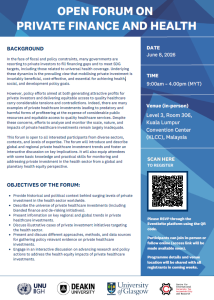
In the face of fiscal and policy constraints, many governments are resorting to private investors to fill financing gaps and to meet SDG targets, including those related to universal health coverage. Underlying these dynamics is the prevailing view that mobilising private investment is invariably beneficial, cost-effective, and essential for achieving health, social, and development policy goals.
However, policy efforts aimed at both generating attractive profits for private investors and delivering equitable access to quality healthcare carry considerable tensions and contradictions. Indeed, there are many examples of private healthcare investments leading to predatory and harmful forms of profiteering at the expense of considerable public resources and equitable access to quality healthcare services. Despite these concerns, efforts to analyse and monitor the scale, nature, and impacts of private healthcare investments remain largely inadequate.
This forum is open to all interested participants from diverse sectors, contexts, and levels of expertise. The forum will introduce and describe global and regional private healthcare investment trends and foster an interactive discussion on key implications. It will also equip attendees
with some basic knowledge and practical skills for monitoring and addressing private investment in the health sector from a global and planetary health equity perspective.
WHEN: Monday 8 June, 2026 – 9:00am – 4:00pm
WHERE: Kuala Lumpur Convention Centre (KLCC), Kuala Lumpur, Malaysia (Room 306)
WHAT’S INCLUDED: Morning Tea, Lunch and Afternoon Tea will be served on a first come first served basis with limited numbers
Reimagining Global and Regional Health Governance: Insights from South and Southeast Asia
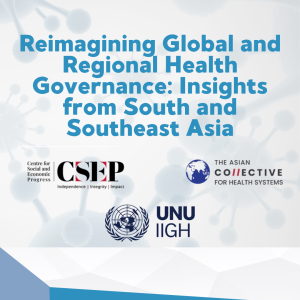
Global Health governance is in turmoil and undergoing a period of rapid and profound transition, shaped by geopolitical dynamics and evolving financing landscapes. In response both to this shafting landscape as well as to the experience of Covid-19, countries in the Global South are making efforts to assert greater agency in shaping the future of global health and in developing more effective models of South-South health cooperation.
The regions of South and Southeast Asia are no exceptions to these efforts and aspirations. Home to a large share of the world’s population and a growing proportion of its economic output, these regions face both threats and opportunities for strengthening their collective health security through improving regional health cooperations and governance, and by working collectively to more effectively influence the future evolution of global health governance.
This panel discussion will examine the evolving global health governance landscape through the lens of South and Southeast Asia and discuss how international health cooperation and both global and regional health governance may be strengthened. It will draw on research findings produced by UNU-IIGH and CSEP to map out the strengths and weaknesses, opportunities and threats for both regions.
WHEN: Monday 8 June, 2026 – 4:30pm – 7:00pm
WHERE: Kuala Lumpur Convention Centre (KLCC), Kuala Lumpur, Malaysia (Room 306)
WHAT’S INCLUDED: Afternoon Tea will be served on a first come first served basis with limited numbers
From Preparedness Policy to Action: Anticipate, Align, and Act for Health Security Preparedness
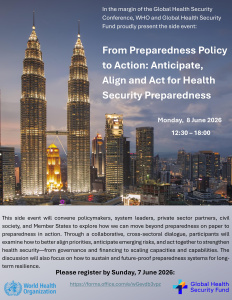
This high-level side event brings together policymakers, technical experts, and partners to explore how global health security can move beyond planning to actionable implementation. Focusing on alignment across sectors, anticipation of emerging threats, and accelerated action, the session highlights governance, financing, technology, and community engagement as critical enablers. Through policy dialogue and practical insights, participants will examine how to strengthen interoperability, mobilize investment, and build resilient, future-ready systems that can effectively prevent, detect, and respond to health emergencies in an increasingly complex global landscape.
WHEN: Monday 8 June, 2026 – 12:00pm – 6:00pm
WHERE: Kuala Lumpur Convention Centre (KLCC), Kuala Lumpur, Malaysia (Room 308-309)
WHAT’S INCLUDED: One Coffee Break with Standing Lunch

- Welcome
- GHS2026
- Registration
- Registration
- Calls For Abstracts
- Calls For Abstracts
- Travel Bursaries
- Information
- About Kuala Lumpur
- Accommodation
- Visa information
- Latest News